
Tunable IR lasers for near-field microscopy
The word "nano" is ubiquitous these days and plays a crucial role in many scientific and industrial fields. On the one hand, it describes a geometric scale, and on the other hand, it indicates a new generation of particles. Due to their small size, nanoparticles have unique properties that do not occur in larger particles of the same material. Whether in paints, cleaning agents or composite materials - science and industry alike are faced with the challenge of precisely identifying these particles and macromolecules, with tunable IR lasers playing an important role.
The need for precise identification methods
There is a great need for precise and material-specific methods, particularly for the chemical identification of nanocomposite materials. Light microscopy is considered an elegant and non-destructive method in which the risk of radiation damage to biological material is almost eliminated. However, this method has its limits, as the optical resolution is not sufficient for the visualization of nanoparticles.
Why infrared spectroscopy reaches its limits
Infrared light is often used to analyze chemical compositions, crystal structures or doping of materials. But infrared spectroscopy also has its limitations. Due to its spatial resolution limit of a few micrometers, it is unsuitable for the imaging of nanoparticles. Analysis on the nanometer scale would be crucial, especially for new types of nanocomposite materials or biological structures such as cell membranes and macromolecules. Tunable IR lasers could be used here.
Revolutionary microscopy techniques
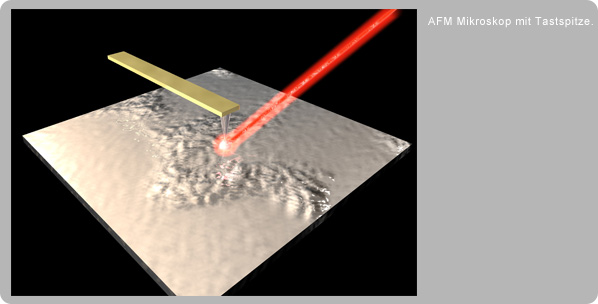
Prof. Hillenbrand's group (CIC Nanogune and Neaspec) has developed microscopy techniques that overcome these challenges. These methods are based on an atomic force microscope (AFM), whose tip serves as a force and scattering probe. A tunable CO2 laser or a quantum cascade laser directs light onto the tip, which is only 10 nm in diameter. The light scattered by the tip provides information about the topography, mechanical and local optical properties of the sample. Tunable IR lasers help to obtain this information precisely.
The advantages of near-field microscopy
This revolutionary technique offers an optical resolution that is independent of the wavelength of the light used. Instead, the resolution depends solely on the tip radius of the AFM probe and is around 10 nm. The tip acts like an antenna and focuses the incident light on an extremely small area. This precise illumination enables an optical near-field interaction between the tip and the sample surface. This changes the intensity of the emitted light depending on the local refractive index of the sample. Thanks to tunable IR lasers, the result is an optical image with a resolution that is not dependent on the limits of diffraction.
The Role of Tunable IR Lasers
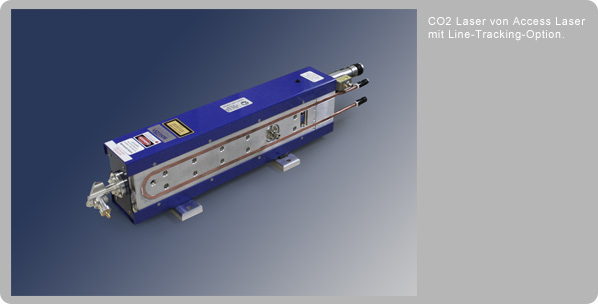
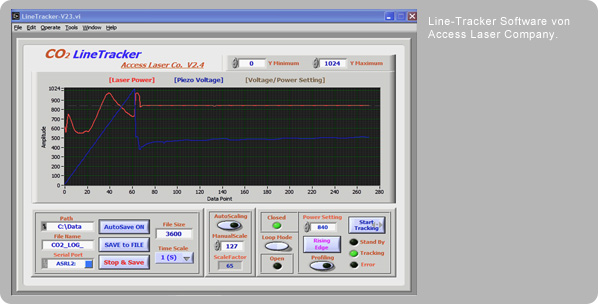
CO2 lasers with a wide tuning range of more than 1.5 µm are proving to be ideal IR radiation sources for these applications. Our partners in the ACCESS LASER COMPANY offer line stabilization solutions, including a line tracker that stabilizes the laser power as well as the longitudinal and transverse mode structure. This makes the application of tunable IR laser sources even more efficient and precise.
Conclusion
Tunable IR laser sources open up new possibilities in near-field microscopy and push the boundaries of optical analysis at the nanometer scale. With their high precision and flexibility, they are ideal for the chemical identification of nanoparticles and complex materials. These technologies are making a significant contribution to advancing research and development in areas such as materials science and biotechnology.