
Characterization of thin film solar cells
Characterizing thin-film solar cells is an important step in quality assurance. Together with the IRDEP (Institute of Research and Development on Photovoltaic Energy), Photon etc. has developed a PL mapper. This device supports the precise analysis of thin-film solar cells.
But why is this important? Thin-film solar cells can exhibit structural defects that impair their performance. To detect such defects early, the photoluminescence method is used. The photoluminescence method is a key technique for characterizing thin-film solar cells. With this light-weak process, the PL-Mapper improves efficiency. It achieves a transmission of up to 80 % and a spectral resolution of 0.3 nm. This allows even the smallest defects to be detected.
The construction of the PL-Mappers has another advantage: it does not require a xy scan device. This saves time and allows for direct visualization of the results on the array camera. In addition to measuring photoluminescence, the device can also measure electroluminescence and diffuse reflectance for comprehensive characterization of thin-film solar cells.
The PL-Mapper is versatile and can be used for both macroscopic and microscopic analysis. This means that users can either examine entire cells or only tiny areas. This way, the characterization of thin-film solar cells is optimally supported by the PL-Mapper during quality assurance.
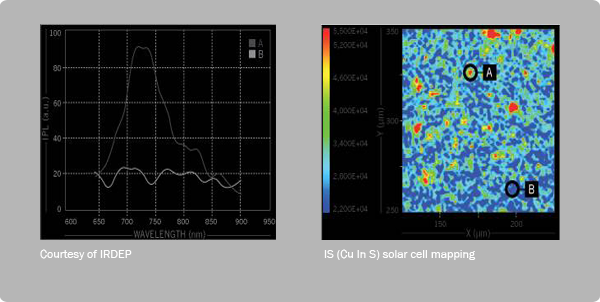
An additional advantage of the PL-Mapper lies in its high adaptability to different applications and materials. Thanks to its flexible configuration, the device can be used not only for thin-film solar cells but also for other semiconductor components and optoelectronic systems. This versatility allows manufacturers to use the same system for different analysis techniques, reducing investment costs and increasing efficiency. Furthermore, the PL-Mapper can be seamlessly integrated into existing production lines, enabling continuous monitoring and control of product quality. This ultimately leads to higher yield and a significant reduction in waste, which is economically advantageous for the solar cell industry.
If you have any further questions contact You are welcome!