Quantum computers
Quantum computers represent a revolutionary advancement in information technology, as they utilize the principles of quantum mechanics to solve problems that are practically impossible for classical computers. Two of the leading technologies in the development of quantum computers are ion traps and aluminum capacitors, which are based on superconducting circuits. These systems utilize different physical approaches to generate and manipulate quantum bits or qubits, the fundamental building blocks of a quantum computer.
Ion traps
Quantum computers with ion traps use ions to generate qubits. These are held in a vacuum by electric or magnetic fields to minimize interaction with the environment and the associated decoherence (the process by which a quantum system loses its quantum mechanical state). The internal energy states of the ions represent the qubit states, for example through the spin of an electron or the orientation of a nuclear spin.

functionality
Blocking the ions: An electromagnetic trap captures and isolates the ions. In doing so, traps use complex electromagnetic fields to stabilize and control the ions in an almost perfect vacuum.
Qubit initialization: Laser cooling and optical pumping techniques place the qubits into a defined initial state (ground state).
Lasers with extremely narrow bandwidth properties are ideal for initializing and manipulating qubits. This allows them to be used with extraordinary precision and low noise to cool the ions and put them into an exact quantum state. The ability to selectively target specific ions without disturbing neighboring qubits is essential for quantum logic operations. The ideal device for this purpose is extremely narrowband laser by OEWaves.
Quantum logic gates: Quantum operations are performed using microwave pulses or laser beams that specifically manipulate the internal states of the ions. By exploiting the quantum entanglement between the ions, complex calculations can be performed.
Measurement: At the end of the calculation, the laser measures the states of the ions. The measurement of the ions leads to the collapse of their quantum states into one of the classical states, which can be read out. The use of polarizers can help to increase contrast and eliminate unwanted stray light. Our Polarizers by Meadowlark are perfectly suited for this.
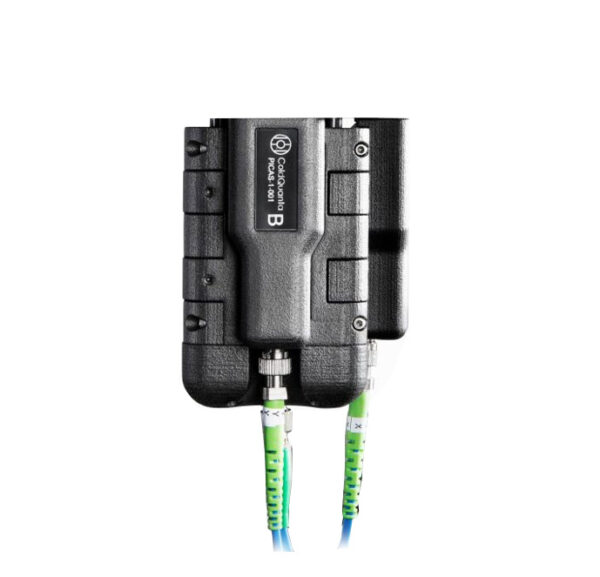
Optics for laser cooling are of great importance for ion traps, especially because they improve the precision and efficiency of the cooling processes. Therefore, they are necessary for the initialization and control of the quantum states of the ions. Inflections PICA (Photonic Integrated Cold Atom Source) is an example of such an innovation that simplifies the handling and application of laser cooling techniques. This reduces the need for large optical structures and enables users to operate quantum systems more efficiently and with less technical effort.
Superconducting circuits (aluminium capacitors)
Quantum computers with superconducting circuits exploit the properties of materials that become superconducting at extremely low temperatures, i.e., conduct electric current without resistance. Aluminium alloys are often used to form Josephson junctions, which serve as the basic building blocks for qubits.

functionality
Superconductivity: To achieve superconducting states, the circuits are cooled to temperatures close to absolute zero. During this state, the circuits exhibit quantum behavior over macroscopic distances.
Qubit initialization: Microwave radiation typically raises the qubits (in a superconducting circuit) to specific energy levels, enabling their initialization.
Quantum logic gates: The manipulation of qubits is carried out by precisely controlled microwave pulses that alter the quantum states of the superconducting circuits. Changes in the current flow or in magnetic fields enable interaction between the qubits.
Measurement: The direct measurement of the electromagnetic properties of the circuits determines the states of the qubits.
Error analysis and maintenance: Polarizers can also be used in imaging systems. They are used to examine superconducting circuits at the microscopic level to make specific details more visible. For this purpose, the polarizers are ideal. Polarizers from Meadowlark.
Comparison and outlook
Both technologies for quantum computers, ion traps, and superconducting circuits offer unique advantages and challenges. On the one hand, ion traps generally provide longer coherence times and the ability to manipulate individual qubits with high precision. On the other hand, superconducting circuits enable faster manipulation of qubits and their integration into existing semiconductor manufacturing techniques, making them attractive for scaling up.
The choice of technology ultimately depends on the specific application and technical requirements. While research in both fields is progressing rapidly, overcoming technical challenges such as scalability, error correction, and minimizing decoherence remains crucial for the future success of quantum computers.