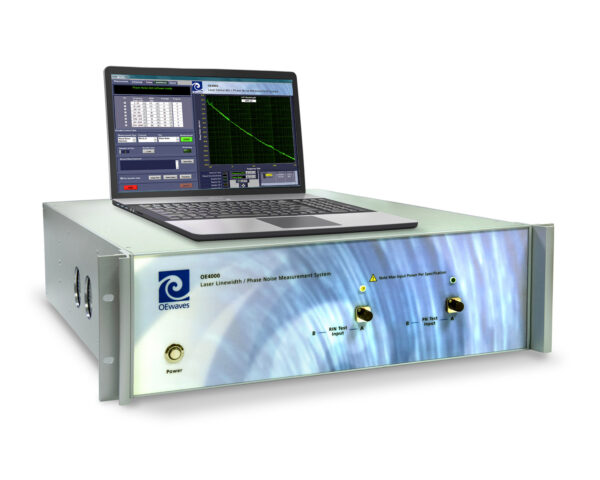
OE4001 – Precise RIN measurement for low-noise laser sources
The OE4001 HI-Q® Laser RIN Analyzer by OEwaves enables the fully automated characterization of the Relative Intensity Noise (RIN) of CW laser sources. The system was specifically developed for applications where even the smallest intensity fluctuations of a laser source can affect measurement accuracy or system performance.
With a noise floor of up to -161 dBc/Hz allows the characterization of particularly low-noise laser sources. For applications with even higher requirements, a XRIN option with a noise floor down to −166 dBc/Hz available.
Accurately characterize Relative Intensity Noise
Relative Intensity Noise describes the temporal fluctuations of the optical output power of a laser relative to its mean power. Especially in highly stable laser systems for metrology, sensor technology, or coherent optical methods, this intensity noise can have a significant impact on the achievable measurement accuracy.
The OE4001 enables fast and reproducible determination of the RIN, making it suitable for both the development and characterization of laser sources and their quality control.
Wide wavelength range
The OE4001 is available in various configurations for multiple wavelength bands between 400 and 2200 nm available. This allows a wide variety of CW laser sources from the visible spectral range to the near-infrared spectral range to be investigated.
Depending on the configuration, measurement bandwidths of 100 MHz to 40 GHz available. This allows the intensity noise to be analyzed for both conventional low-noise laser sources and demanding high-frequency applications.
Typical applications
The OE4001 is particularly suited for the characterization of low-noise laser sources in demanding optical systems. Typical application areas of the HI-Q® test and measurement systems from OEwaves include, among others:
- Optical sensing and interferometric measurement techniques
- LIDAR
- Gas spectroscopy and gas sensing
- Optical Metrology and Spectroscopy
- Coherent optical communication
- Development and Characterization of Laser Sources
- Research and Test & Measurement
OEwaves also cites applications such as acoustic sensing and distributed temperature and strain sensing for its HI-Q® test and measurement systems.
Advantages of the OE4001
- Fully automatic RIN measurement
- Noise Floor to −161 dBc/Hz
- Down to -166 dBc/Hz with XRIN option
- Various wavelength bands between 400 and 2200 nm
- Measurement bandwidths up to 40 GHz
- Suitable for ultra-low-noise CW laser sources
- Fast and reproducible laser characterization
OE4001 by OEwaves
The OE4001 HI-Q® Laser RIN Analyzer offers a specialized solution for the precise measurement of the intensity noise of modern CW laser sources. Together with the other HI-Q® measurement systems from OEwaves, it enables a comprehensive characterization of laser noise, making it particularly suitable for research, development, and demanding optical metrology.
Soliton will assist you in selecting the appropriate OE4001 configuration for your laser source, the required wavelength range, and the desired measurement bandwidth.