
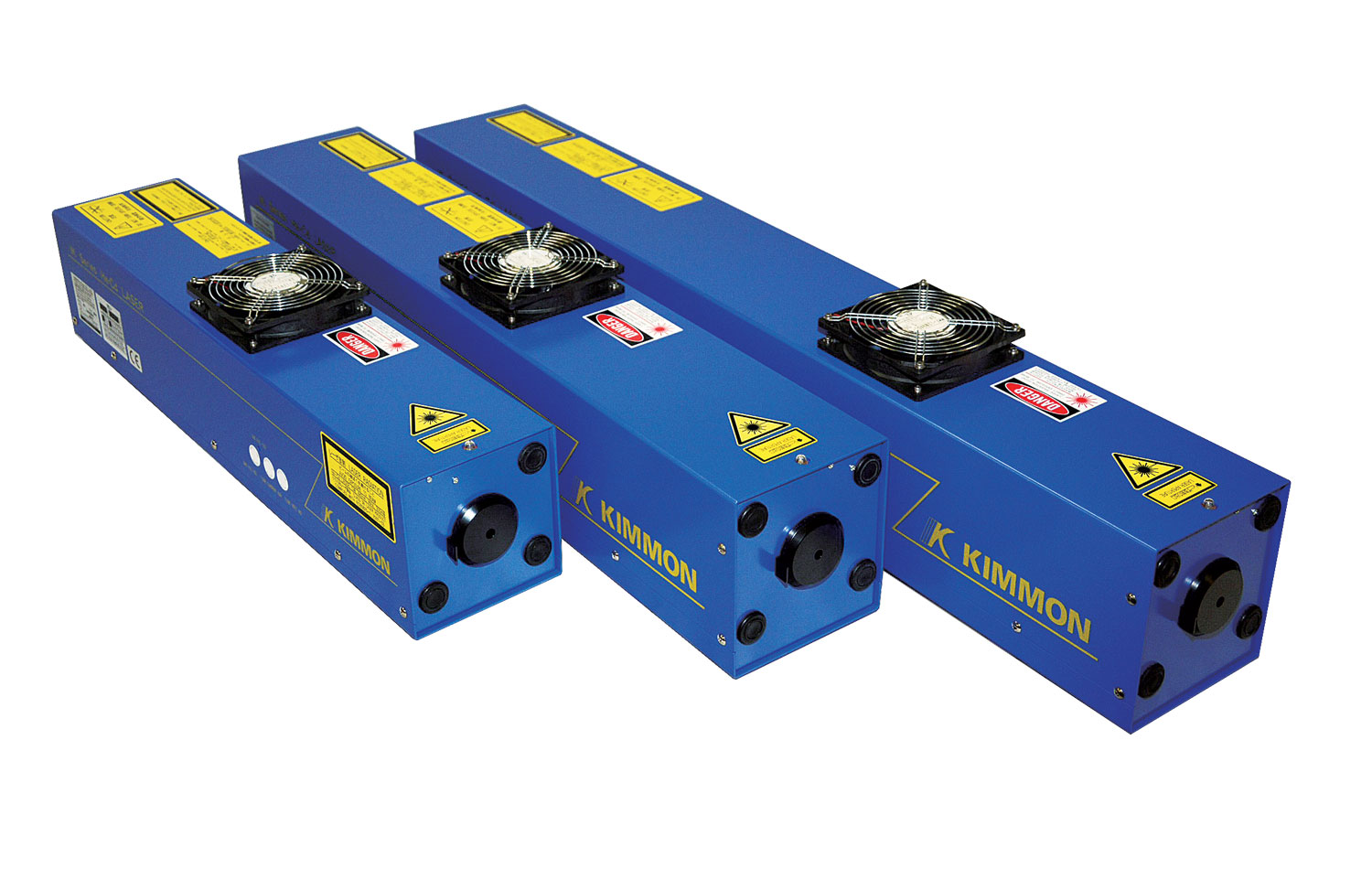
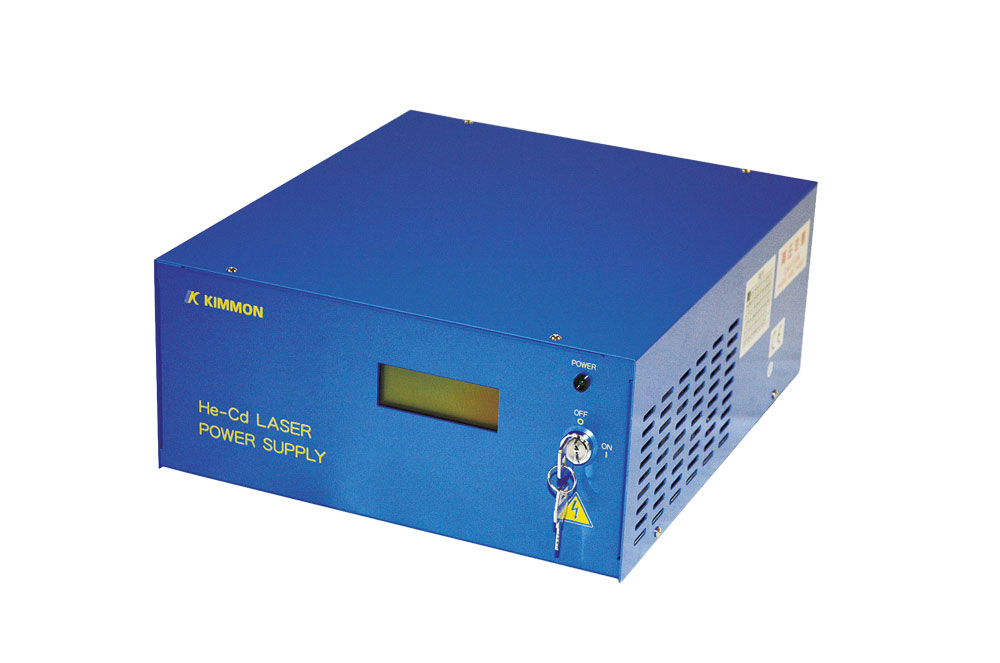

Helium-Cadmium laser for demanding scientific and industrial applications
The Helium-Cadmium Laser (HeCd) by Kimmon Koha are continuously emitting gas lasers for applications where high spectral purity, good beam quality, and high coherence are required. The systems are equipped with 325 nm in the UV range, 442 nm in the visible blue spectral range as well as Dual-wavelength laser with both wavelengths available.
Kimmon Koha has been working on the development of gas lasers since 1966 and began 1971: began manufacturing HeCd lasers. According to the manufacturer, as of 2019, more than 46,000 HeCd laser systems sold. As a result, Kimmon has decades of experience with this specific laser technology.
The current product family includes numerous performance levels and beam configurations. Depending on the application, available are TEM₀₀ single-mode or TEMmn multi-mode systems are available. At 325 nm, the specified output powers range up to 100 mW; at 442 nm, up to 180 mW. In addition, Kimmon offers dual-wavelength systems that emit both wavelengths simultaneously.
325 nm UV HeCd laser
The UV models emit at 325nm and are particularly well-suited as a source of excitation for spectroscopic and materials science studies.
An important area of application is the Photoluminescence (PL). Short-wavelength UV radiation can be used, for example, to study semiconductor materials. Kimmon specifically cites the study of lattice defects in GaN semiconductor crystals as an application for 325-nm lasers.
Other potential applications include Raman spectroscopy, holography, and coherent exposure techniques.
442 nm HeCd laser
The ones at 442 nm Emissions-reducing models offer higher output power of up to 180 mW and are suitable for applications in the visible blue spectral range.
Kimmon lists 442-nm HeCd lasers, for example, for Direct Imaging. In the process, photosensitive materials can be exposed directly using the laser without prior production of a conventional photomask.
Thanks to their combination of short wavelength, continuous emission, and high coherence, HeCd lasers are also ideal for interference and holographic applications.
Dual-wavelength HeCd laser
For applications that require two excitation wavelengths, Kimmon offers Dual-wavelength systems with 325 nm and 442 nm an.
The current series includes both TEM₀₀ single-mode and multimode variants. Depending on the model, simultaneous emission provides output powers of up to 30/110 mW in single mode or rather 40/150 mW in multi-mode available.
I think this is particularly worth mentioning for your site because the two drop-down menus at the top, „325 nm“ and „441.6 nm,“ currently give the impression that you always have to choose one Wavelength is the deciding factor.
Typical applications
I would tidy up the existing area a bit and align it more closely with Kimmon's current information:
- Raman Spectroscopy
- Photoluminescence
- Semiconductor and material characterization
- Holography
- Fabrication of holographic and optical gratings
- interference exposure
- Direct Imaging and Lithography
- Fluorescence excitation
- microscopy
- Research and Development
On his current product page, Kimmon explicitly lists photoluminescence, Raman spectroscopy, holography, direct writing, and multi-beam interference lithography as typical HeCd applications.
High coherence for holography and interference methods
A particular strength of HeCd lasers is their suitability for coherent optical processes. In interference lithography, for example, the laser beam is split into multiple beam paths and then superimposed on a photosensitive surface. The resulting interference patterns can be used to produce very fine periodic structures and optical gratings. Kimmon specifies structures ranging from several hundred to about a thousand lines per millimeter in this context.
Raman spectroscopy and photoluminescence
The wavelengths of 325 and 442 nm make HeCd lasers interesting excitation sources for spectroscopic methods. In the Raman Spectroscopy they are used, among other things, for the structural analysis of organic and inorganic compounds as well as for the analysis of semiconductor nanocrystals.
At the Photoluminescence in particular, the UV wavelength of 325 nm enables the excitation of various semiconductor materials and the investigation of defects, impurities, and material properties.
Advantages of Kimmon HeCd Lasers
- UV and visible laser emission from an established laser technology
- 325 nm and 442 nm available
- Dual-wavelength systems available
- Output powers up to 100 mW in the UV
- Output powers up to 180 mW at 442 nm
- TEM00 single mode and multimode available
- High coherence
- Suitable for demanding spectroscopic methods
- Wide range of scientific and industrial applications
- Extensive model range
Manufacturer
Kimmon Koha Co., Ltd. is a Japanese manufacturer of laser sources with special expertise in the field of helium-cadmium lasers. The development of gas lasers began in 1966, and the production of HeCd lasers in 1971. In addition to HeCd lasers, Kimmon now develops and produces UV and high-power fiber lasers, among others. According to the manufacturer, the design, assembly, alignment, and testing of the laser systems are largely carried out in-house.


