polarization techniques
This application note provides an overview of polarized light, retardation, and the main tools for manipulating the polarization state. The description of polarization techniques covers the functionality and application of common light manipulation devices such as optical isolators, light attenuators, polarization rotators and variable beam splitters.
light polarization
In classical physics, light of a single color is described by an electromagnetic field in which electric and magnetic fields oscillate at a frequency (ν) related to the wavelength (λ). This is expressed by the formula C=λνC = λνC=λν, where c is the speed of light. Visible light has wavelengths between 400 and 750 nm.
This formula shows how polarization techniques can be used specifically to influence the properties of light in optical systems. A key concept here is the polarization state, which is determined by the orientation of the electric field and can be changed or enhanced depending on the application. This targeted control is a central aspect of polarization techniques.


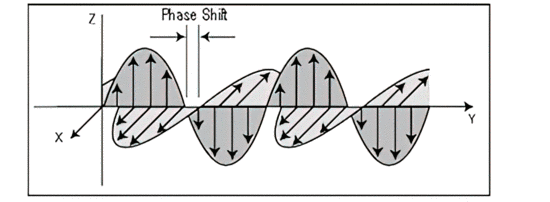
Circularly polarized light occurs when a linear component of the electric field is phase-shifted by λ/4. Elliptically polarized light occurs when the phase shift between the field components is arbitrary.
We create linearly polarized light by passing unpolarized light through a polarizing medium. A polarizer blocks components that are not aligned with its axis. Vertically polarized light sent through a polarizer at 45° reduces its amplitude to a factor of 1/√2 and halves its intensity. A horizontally aligned polarizer does not allow vertically polarized light to pass through.
delay
A phase retarder can extend the optical path length for a polarization. This changes the polarization state and enables targeted applications.
Lambda/4 plate:
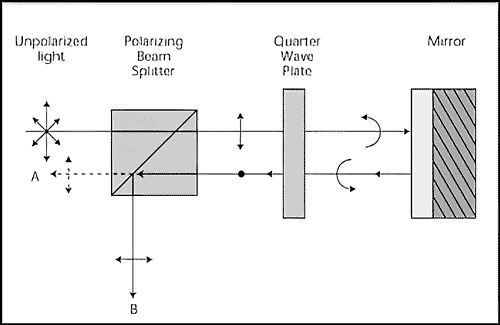
A lambda/4 plate creates a phase shift and converts elliptically polarized light into linearly polarized light. With birefringent materials, this delay is caused by the fast and slow axes of the plate. A linear polarizer and a mirror are used for alignment.
Lambda/2 plate
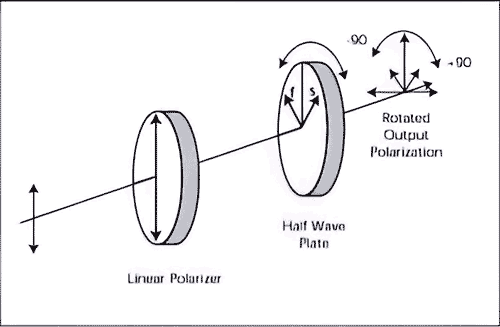
The Lambda/2 plate (half-wave plate) is another important element in polarization techniques. It creates a phase shift of 180 degrees (λ/2) between the orthogonal components of the electric field. This particular delay causes a rotation of the plane of polarization of linearly polarized light. If the fast axis of the lambda/2 plate is placed at a certain angle to the plane of polarization of the incident light, the polarization rotates by twice the angle of the orientation of the plate.
In the case of circularly polarized light, the lambda/2 plate also reverses the polarization - it changes the so-called "handedness" of the light from right-handed to left-handed or vice versa. This property is particularly valuable in optical signal processing, where precise control of the polarization state is required.
Difference between Optical Isolators and Attenuators
Optical isolators
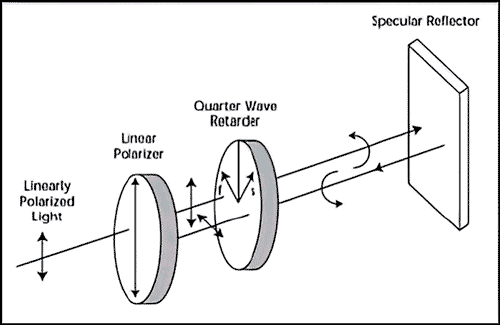
Optical isolators are important components in laser technology and telecommunications. They prevent light from being reflected back into a light source in order to maintain its stability and prevent damage to sensitive components. An optical isolator combines a linear polarizer and a lambda/4 plate (quarter wave plate). First, the linear polarizer polarizes the incoming light in a fixed plane. The lambda/4 plate then converts the linearly polarized light into circularly polarized light. When this light is reflected and passes back through the isolator, the circularity of the polarized light is reversed. Passing through the lambda/4 plate again rotates the light into a plane of polarization that is perpendicular to the original direction. The polarizer then blocks this returning light and prevents feedback.
Optical attenuators
Optical attenuators work in a similar way, but with a different goal. A half-wave plate (lambda/2 plate) is inserted between two crossed Polarizers so that without a retarder no light passes through the system. However, the half-wave plate can rotate the incident light by a controlled angle so that a certain amount of light is allowed to pass through. Depending on the orientation of the half-wave plate's fast axis to the polarization of the light, the transmission between the Polarizers can be continuously controlled. Optical attenuators are used in optical measuring systems and in laser technology to precisely control the light intensity without affecting the light source itself.

polarization rotator
A polarization rotator uses the properties of a lambda/2 plate to rotate the plane of polarization of linearly polarized light. The light is passed through the lambda/2 plate, rotating the polarization by twice the angle of the plate's alignment with the plane of polarization. For example, a 22.5° alignment of the lambda/2 plate's fast axis with the plane of polarization results in a 45° rotation of the polarization. This ability to precisely rotate the plane of polarization is useful in optical systems and in experiments where precise control of the light polarization is critical.
Variable beam splitter
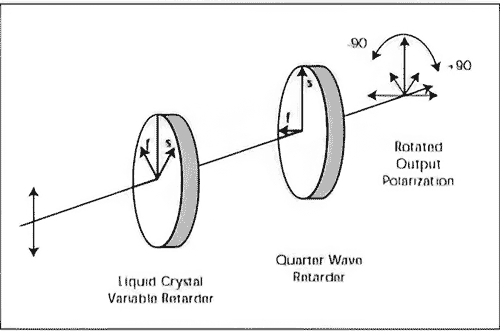
A variable beamsplitter uses a combination of a half-wave plate and a polarizing beamsplitter to control the amount of light transmitted and reflected. The half-wave plate rotates the polarization of the incident light so that at a given plane of polarization it either passes more light through the beamsplitter or reflects more light. If the half-wave plate's fast axis is aligned parallel to the input polarization, it reflects all of the light; if it is rotated 45°, it passes most of the light. In modern systems, a variable retarder replaces the half-wave plate, allowing continuous light control without mechanical movement. This configuration allows precise control of light distribution and is used in optical networks, imaging systems, and precision measurement instruments.
Conclusion
In this application note we have given a basic description of light polarization and some of the tools for controlling the polarization state of light. Retarders andPolarizershave been used in simple devices that allow some of the usual manipulations required wherever light is measured.

See all our polarizers here: