
Brief explanation
Batteries are electrochemical energy storage devices that convert stored chemical energy into electrical energy. Depending on their cell chemistry, they differ in energy density, performance, lifespan, safety, and cost. Rechargeable batteries are referred to as secondary cells or accumulators.
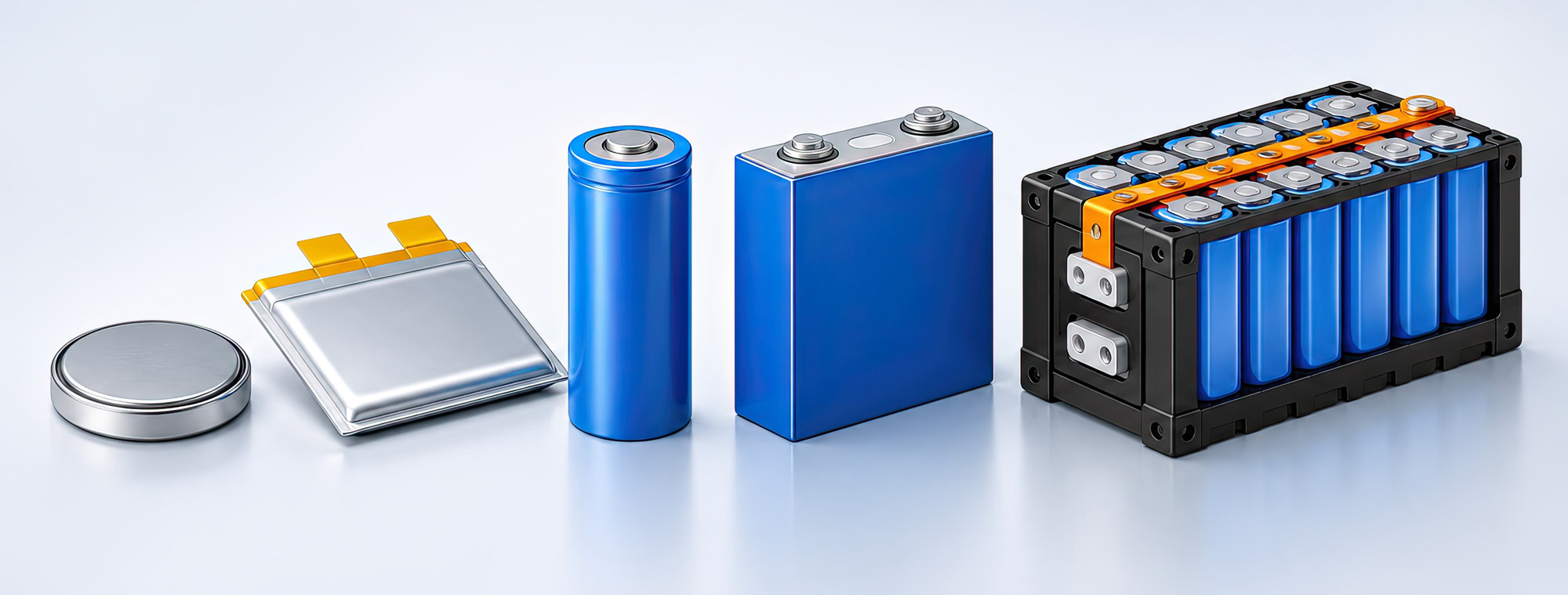
Overview of battery types
Lithium-ion batteries
Lithium-ion batteries are among the most important rechargeable energy storage devices. They are characterized by a high energy density and a relatively high efficiency. Their properties depend significantly on the electrode materials used and the cell chemistry.
They are used, among other things, in electric vehicles, smartphones, tools, and stationary storage systems. Challenges exist particularly in terms of raw material requirements, aging, safety, and recycling.
Lithium-sulfur batteries
Lithium-sulfur batteries are considered a promising approach for particularly lightweight energy storage due to their high theoretical specific energy.
Currently, among other things, the so-called polysulfide shuttle effect, volume changes during operation, and the limited cycle life limit the practical application. Therefore, research focuses on more stable electrodes, electrolytes, and cell concepts.
Solid-state batteries
Solid-state batteries use a solid electrolyte instead of a conventional liquid electrolyte. Depending on the cell design, they can offer advantages in terms of safety and energy density, especially when combined with lithium metal anodes.
Technical challenges include the stability of the interfaces between electrodes and electrolyte, the ion conductivity, and industrial manufacturing. The technology is being intensively developed; its properties depend strongly on the specific cell structure.
Sodium-ion batteries
Sodium-ion batteries use sodium ions as the charge carriers. Sodium is relatively readily available and can reduce the dependence on certain critical raw materials.
The technology is particularly suitable for applications where cost, raw material availability and lifespan are more important than the highest possible energy density. However, its actual environmental impact depends on cell chemistry, manufacturing, lifespan, and recycling.
Redox flow batteries
Redox flow batteries store energy in electrochemically active liquids that are usually stored in external tanks and pumped through an electrochemical cell.
A key advantage is that energy storage capacity and power can be dimensioned largely independently of each other. This makes these systems particularly suitable for stationary applications with larger storage capacities.
Disadvantages include the relatively low energy density, the additional space requirement, and the complexity of the system.
Graphene-based battery technologies
Graphene is being researched as a conductive material and as a component of novel electrode structures. It can, for example, contribute to improving the electrical conductivity, the mechanical stability, or the charge transport within an electrode.
However, the term „graphene battery“ does not refer to a uniform cell chemistry. Often, these are existing battery technologies whose electrodes are optimized using graphene-containing materials.
The practical advantages depend heavily on the quality of the material, the cell structure, and the manufacturing process.
Battery technologies play a central role in electric mobility, mobile electronics, and stationary energy storage. Depending on the application, different requirements are imposed on energy density, charging speed, lifespan, safety, and cost-effectiveness.
Sustainability and recycling
In addition to performance, the availability of raw materials, the energy required for production, and the recyclability are becoming increasingly important.
Modern recycling processes enable the recovery of valuable materials from used batteries. However, the sustainability of a battery technology can only be assessed based on its entire life cycle – from raw material extraction through production and use to recycling.
Conclusion
There is no single battery technology that is optimally suited for all applications. Lithium-ion batteries dominate many current applications, while sodium-ion, solid-state, and lithium-sulfur systems offer additional possibilities.
Redox flow batteries offer particular advantages in stationary storage, while new electrode materials such as graphene can contribute to the further development of existing cell concepts.
The key factor remains the selection of battery technology for the respective application – taking into account performance, cost-effectiveness, safety, and environmental compatibility.